Friday, July 5, 2013

Skyenimals Spotlight on Phillips Park Zoo in Aurora, Illinois.

From bald eagles to wolves the 98 year old Phillips Park Zoo entertains over 200,000 visitors per year. At almost 100 years old, Phillips Park Zoo is quickly approaching it's centennial in 2015. Phillips Park Zoo is a small, no entrance fee, zoo in Aurora, Illinois that features primarily North American wildlife.

River Otter at Phillips Park Zoo
With more than 80 animals and over 40 different species this quaint zoo gives Aurora residents and visitors plenty to see. Three of the most popular animals with visitors are the North American river otters, mountain lions and the wolves. The reptile house is also a popular destination with zoo guests.


Alligator in the Reptile House at Phillips Park Zoo

Although there is a limited amount of land at Phillips Park Zoo, the animals are provided ample exhibit space. The zoo prefers to house fewer animals comfortably instead of trying to house more animals in smaller exhibits. The elk and wolves, for example, have very large exhibits. These exhibit sizes rival those you may see at many larger and nationally recognized zoos.


Barred Owl at Phillips Park Zoo
In addition to housing animals in good sized exhibits, the zoo is also home to many rescue animals. Some of the rescued animals at the zoo include owls, eagles and various birds of prey. Many of the rescues have permanent disabilities that prevent them from being released back into the wild.

Gray Wolf at Phillips Park Zoo, in Aurora, IL
Any zoo of 98 years undoubtedly has a lot of history and has experienced a large amount of change, and Phillips Park Zoo is no exception. In its early years, the zoo was home to exotic animals such as monkeys and giraffes. Phillips Park Zoo changed its focus to native animals after nearby Brookfield Zoo opened in 1934. In 1937, Mastodon bones and tusks were found during the digging of a lake on the property. These Mastodon fossils are now on display at the main visitors center of the zoo.
Mastodon statue at Phillips Park Zoo
Many people who grew up in Aurora or the western suburbs of Chicago remember Phillips Park Zoo as a place to see American black bears. Unfortunately, the zoo hasn't had any black bears since their last bear died of cancer over a decade ago.  However, this may change someday. The zoo has considered expansion with the hopes of bringing back black bears to the zoo. Of course, a change like this is complicated and would require additional fund raising or a substantial donation.

The zoo continues to add new animals through rescue and breeding programs it participates in. Recent additions include two barn owls (July 2013). The zoo is also looking into adding two wolf cubs to the current wolf pack. Be sure to "like" the Phillips Park Zoo facebook page for news and updates. You can also "like" the Skyenimals facebook page for pictures from Phillips Park Zoo and many other places.

Phillips Park Zoo is open year round, and hosts several special events throughout the year. Check the Phillips Park Aurora web site for zoo hours and event information before visiting. And, of course, watch for additional centennial celebration information leading up to the 2015 season!

Want even more information and pictures from Phillips Park Zoo? Then check out the Skyenimals' Phillips Park Zoo page. If you visit the zoo and get any good pictures please share them here or on skyenimals.com!


Thursday, June 27, 2013

Gatorland Sights and Sounds!

Wow! I was truly amazed by some of the sights and sounds I saw at Gatorland during my visit in June 2013. I had visited Gatorland in Orlando, Florida in June 2012 and loved it. Feeding the alligators, watching the shows, and the birds!

Bird's eye view of Gatorland from the three story tower observatory.

When I returned to Florida a year later I knew I was going to visit Gatorland again. This visit was even better. There was a threat of rain and some sprinkles now and then, but I decided to go anyway. I arrived just after 4pm on this overcast day, not expecting much and thinking I might even get rained out. I was greeted at the ticket booth with the news that since the park was closing in less than two hours admission was half price. Sweet!

I stopped and talked to the lady selling hot dogs to feed to the gators. We talked about the storms that had been in the area (there was a tropical storm coming in from the gulf). She mentioned that it was mating season for the gators and they were sometimes more active during overcast and rainy times.

I decided to walk through the outdoor parts while the rain held off. I stopped and fed the Emu's on the way toward the back of the park. The Emu's are so funny. Check out this Emu Feeding Time video!

Emu Closeup (photo taken at Gatorland, Orlando, FL)
Being in Gatorland isn't like being in a zoo. This is like being in the wild, with only a raised planked walkway and a fence separating you from the swamp and gator areas.

It's amazing to watch the herons, egrets and other birds nesting, preening and frolicking in the trees, nearly oblivious to a quiet visitor. This isn't at all like watching birds in a zoo. These birds choose to live and breed here, they have built their nests where they chose and there's no cage to hold them. The birds are lively and lovely.

Snowy Egret
After walking through the park and taking many photos a strange sound started coming from the water areas. It sounded like nothing I had heard before. Sort of like an elephant. It was the gators making their deep bellowing mating calls. The calls carry far through the area and are quite loud when you are near a gator making the call. One of the visitors stopped me and asked "what is that sound"? I said I think it's the gators. Sure enough, it was soon confirmed where the sound was coming from. As there was a small group of people watching a couple of nearby gators who were making the call.

Want to hear the sound? Check out this Alligator Mating Call video. It can't quiet compare to hearing it in person, but you'll get an idea of what it sounds like.

Gator Mating Call
Before leaving the marsh area I decided to go up to the top of the three story observatory. I really didn't know what to expect since I had never been up there before. Simply put, it was awesome!

Instead of feeling further away from everything it gave you a sense of the scope of nature. It was cool to see the gators swimming individually or in small groups from this height. It was also neat to see the trees dotted with bright white egrets. But the best surprise seen from the observatory was a being able to look down into a nest built in a tree very close to the top level of the observatory.

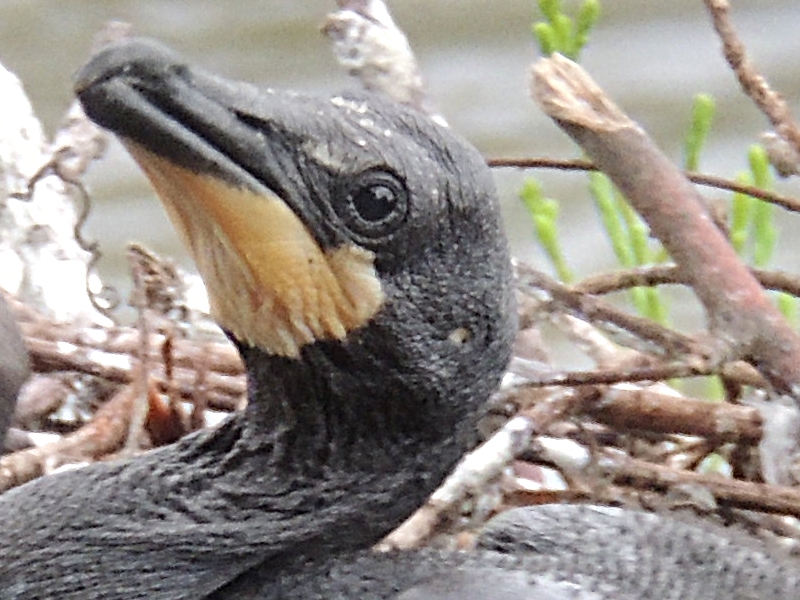
There was a pair of Double-crested Cormorants in the tree. One was on the nest and one was nearby on the same branch. I didn't take much notice of them at first, but after taking a look around I went back and realized they had young, featherless chicks in the nest.

The young ones were hungry and squawking for food! Such a site. Take a look at this Double-crested Cormorant Family video.

Double-crested Cormorant chick
Well, I ran my camera out of batteries and memory before heading in from the marsh area. I spent the little bit of time I had left looking at the giant tortoises, the new panther exhibit and, of course, more alligators.

American Alligator at Gatorland Orlando.
If you're an animal lover don't skip Gatorland. It's a really cool place. And if you go and get some good pictures we'd love to see them. Post below or upload them to Skyenimals, an animal website for kids! Checkout our gator wallpaper images, bird wallpaper images and all our favorite pictures from Gatorland on the Skyenimals Gatorland page.

Saturday, May 18, 2013

Animals of the Coniferous Forest

CONIFEROUS FOREST
© Nobilior - Fotolia.com
Coniferous forests are home to the world's toughest trees. The evergreen trees in these forests live through extreme weather conditions. Coniferous forest types include the huge boreal forests in the northern hemispehere and the much smaller temperate rainforests, such as America's Pacific Northwest.

A large number of animal species make their home in coniferous forests. A wide variety of mammals, invertebrates, and birds live in the coniferous forests.

Some of the most famous animals of the Coniferous Forest


Elk in Rocky Mountain National Park © Jeff Slater


Elk

Elk are one of the largest species of deer. Male Elk have very large antlers which are shed each year. Elk often live in or near the edges of coniferous forests. 


Wolverine

Wolverines live in cold northern areas of North America and Asia. The Wolverine is a large member of the weasel family.

© Jeff Slater

Wolf

The Gray Wolf was once one of the world's most widely distributed mammals. Wolves have declined in number because of man made changes in land usage. Now, many of the 39 sub-species of the Gray Wolf make their home in Coniferous Forests.


Visit the Skyenimals list of coniferous forest animals for many more! Or, check out the full list of animal habitats if you are interested in other animal habitats.